The Barlin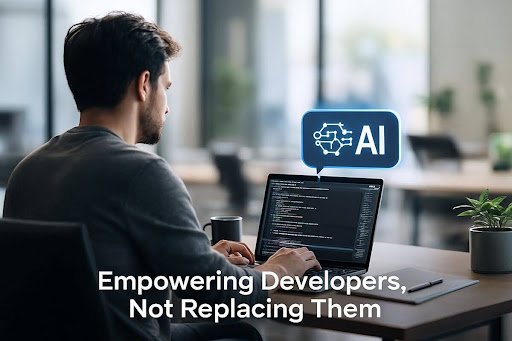
You’ve probably seen the headlines. “AI is taking over.” “Developers will be obsolete.” All that noise. But let’s pause for a second—do we really think AI can replace developers?
Not quite. Not now, not soon.
What AI is actually doing is changing how we work, not who does the work. The smarter move isn’t fearing the tech, but figuring out how to use it. And when it comes to software development, that’s exactly what’s happening.
Let’s break this down.
Can AI Write Code?
Sure, AI can write code snippets. It can complete functions, suggest fixes, and even generate small programs. But that’s just surface-level.
Software development isn’t just about typing code. It’s about understanding user needs, thinking through edge cases, managing integrations, debugging issues that don’t make sense on paper, and communicating with other humans on the team. That’s a whole other game.
Even when AI writes good code, someone still has to review it. Validate it. Test it. Deploy it. Maintain it. Real-world software isn’t a school project—it’s alive and kicking long after launch day.
So can AI help with coding? Yes.
Can it build a scalable, secure, production-ready system by itself? Not even close.
How We Actually Use AI in Software Projects
Let’s not pretend AI isn’t helpful. It is. At our software development company in the USA, we use AI tools every day—but we use them smartly.
Here’s where AI makes a difference:
1. Auto-suggestions and Error Fixes
Developers use AI-enhanced code editors that suggest what you’re probably about to type. These tools can also point out bugs or issues before the code is even run. It’s kind of like spell-check for coding. Speeds things up. Cuts down silly mistakes.
2. Test Generation
Writing test cases can be tedious. AI helps generate them based on the code. That way, developers can spend less time on boilerplate work and more time solving actual problems.
3. Documentation
Nobody likes writing documentation. AI can draft basic docs based on the code. Developers just tweak it for accuracy. Again, time saved.
4. Task Automation
From running scripts to setting up deployments, a bunch of repetitive tasks can now be triggered automatically with AI. Fewer manual steps. Fewer errors.
So yeah, AI is helpful. But it’s not calling the shots.
What Developers Actually Do (That AI Can’t Touch)
Here’s the part folks often skip when talking about AI replacing developers. Developers don’t just build things—they solve problems.
Imagine a retail business wants a new app. Developers have to:
- Understand the business logic
- Ask questions stakeholders didn’t think of
- Recommend the right tech stack
- Prioritize features for version one
- Plan for future scalability
- Consider how the app fits into the company’s systems
- Create something people actually want to use
Can AI do that? Not even on its best day.
Human intuition, business sense, and creativity still matter. And those don’t come from a chatbot or code generator.
What’s Changing in the Developer Role
Now let’s be real—things are changing. The job of a developer is evolving (not being replaced).
Developers are spending less time on manual stuff. More time thinking critically, reviewing AI-generated code, focusing on performance, security, architecture, and design. More strategy, less repetition.
That’s actually a good thing.
It means developers can work faster without sacrificing quality. It means teams can deliver more in less time. And that’s exactly how we approach things at our software development company in USA—AI handles the grunt work, our developers focus on the heavy lifting.
Hiring Developers in the Age of AI
Hiring devs today isn’t about who can memorize syntax or who writes the cleanest loop. It’s about who can think, adapt, and solve real-world problems—fast.
That’s why tools like an AI Hiring tool are starting to pop up. These tools don’t just screen resumes. They analyze patterns, review coding assessments, even pick up on soft skills through virtual interviews.
But even then, hiring managers make the final call. AI might shortlist, but people still hire people. Gut feeling, culture fit, communication—it all still matters.
At the end of the day, tech helps filter, not decide.
So, Should You Worry About Your Job?
If you’re a developer: no, you shouldn’t worry. Unless your job is 90% copy-pasting Stack Overflow answers, you’re fine.
If you’re a business owner or team lead: your focus should be on hiring developers who can work with AI, not be replaced by it.
The smart ones aren’t scared of AI. They use it like a power tool. Because that’s what it is.
How AI Speeds Up the Software Development Process
If you’ve ever worked with a dev team, you know how projects can drag. Timelines stretch. Bugs pop up. Features get reworked five times.
AI shortens the loop.
From planning to testing to fixing bugs, things just move quicker with the right tools in place. Developers aren’t stuck waiting. Teams aren’t blocked. And that means faster releases, better feedback cycles, and more consistent results.
At our software development company in USA, we’ve seen projects go from idea to MVP in half the time, just by using AI properly. Not to replace people, but to support them.
That’s the sweet spot.
What About Long-Term Trends?
Let’s zoom out a bit. What are the big software development trends to keep an eye on? Here’s a quick list:
- AI-assisted coding: This is already here. Expect it to get better, but still need human oversight.
- DevOps and Automation: More automation in testing, deployment, and monitoring.
- Cloud-native development: Serverless, containerized apps are becoming standard.
- Low-code/no-code tools: More non-developers can build simple apps. But devs are still needed for the complex stuff.
- Security-first development: As threats grow, security isn’t an afterthought anymore.
All of these trends point in one direction: developers working smarter, not harder.
The key is adaptability.
Final Thoughts: AI Isn’t Here to Steal Jobs. It’s Here to Shift the Game.
There’s no AI takeover. Just a shift in how things get done.
Developers who stick to old ways might feel the pressure. But the ones who adapt? They’ll be in more demand than ever.
Companies that know how to blend human skill with AI speed are already ahead of the curve. That’s what we focus on at our software development company in USA. AI doesn’t run the show—it supports the team.
And for anyone worried about AI replacing people, here’s a thought: the best software still needs a human touch. Every time.
Want to build faster? Smarter? Without losing quality? Use AI. But don’t leave the developers out of the picture.
Because at the end of the day, software isn’t just built by code. It’s built by people who know how to think.